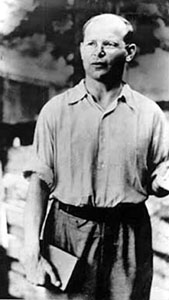
Showing posts with label D. Bonhoeffer. Show all posts

Saturday, 11 April 2009

Passionszeitzitate

Heute ist Karsamstag, der letze Tag der Passionszeit. Unten sind Zitate die mir entweder besonders angesprochen haben oder mir zum Nachdenken gebracht haben:

Menschen gehen zu Gott,
in ihrer Not,
flehen um Hilfe,
bitten um Glück und Brot,
um Errettung aus Krankheit,
Schuld und Tod.
So tun sie all, alle,
Christen und Heiden.

Menschen gehen zu Gott
in Seiner Not,
finden ihn arm, geschmäht,
ohne Obdach und Brot,
sehn ihn verschlungen von Sünde,
Schwachheit und Tod.
Christen stehen bei Gott
in Seinen Leiden.

Gott geht zu allen Menschen
in ihrer Not,
sättigt den Leib und die Seele
mit Seinem Brot,
stirbt für Christen und Heiden
den Kreuzestod,
und vergibt ihnen beiden.

DIETRICH BONHOEFFER

Seid so unter euch gesinnt, wie es auch der Gemenschaft in Christus entspricht:

Er, der in göttlicher Gestalt war, hielt es nicht für einen Raub, Gott gleich zu sein, sonder entäußerte sich selbst und nahm Knechtsgestalt an, ward den Menschen gleich und der Erscheinung nach als Mensch erkannt.

Er erniedrigte sich selbst und ward gehorsam bis zum Tode, ja zum Tode am Kreuz.

Darum hat ihn auch Gott erhöht und hat ihm den namen gegeben, der über alle Namen ist, daß in dem Namen Jesu sich beugen sollen aller derer Knie, dei im Himmel und auf Erden und unter der Erde sind, und alle Zunge n bekennen sollen, daß Jesus Christus der Herr ist, zur Ehre Gottes, des Vaters.

PHILIPPERBREIF 2, 5-11.

Laßt uns alle vor seinem Kreuze schweigen; wir alle sind anders als er und sind vor ihm alle schulding.

STEFAN ANDREAS

Stirb mit dem, der lebt, daß du auferstehst mit dem, der gestorben ist, und lebst mit dem, der auferstanden ist.

RAPHAEL ROMBACH

Seine Gerechtigkeit gegen mich hätte ich begriffen, seine übermäßige Liebe ist unbegreiflich.

STEFAN ANDREAS

Das Kreuz Christi ist eine Last von der Art, wie es die Flügel für die Vögel sind. Sie tragen aufwärts.

BERNHARD VON CLAIRVAUX

Golgotha

Drei Räuber
kreuzigt man heute
auf Golgoth:

Der linke nahm mir mein Geld
der rechte nahm mir mein Gut
der in der Mitte nahm mir meine Schuld.

Auf Golgotha
kreuzigt man heute
drei Räuber.

LOTHAR ZENETTI

Der den Wein austeilt, / muß essig trinken.
Der die Hand nicht hebt zur Abwehr, / wird geschlagen.

Der den Verlassenen sucht, / wird verlassen.
Der nicht schreien macht, / schreit überlaut.

Der die Wunde heilt, / wird durchbohrt.
Der den Wurm rettet, / wird zertreten.

Der nicht verfolgt, hicht verrät, / wird ausgeliefert.
Der nicht schuld ist, der Unschuldige / wird gequält.

Der lebendig macht, / wird geschlachtet.
Der die Henker begnadigt, / stirbt gnadenlos.

RODOLF OTTO WIEMER.

Thursday, 28 August 2008

The Spirit, Bonhoeffer and Gunkel

If it's the case, as I argued in my post The Spirit and inspiration in theological exegesis, that the human words of Scripture become a means of revelation by the operation of the Holy Spirit, what does that look like in practice? Childs attempted to answer this question in his fascinating article "Interpreting the Bible Amid Cultural Change," Theology Today 54 (1997), 200-211.

He turns to a major source of personal inspiration: the Germany theology of the Confessing Church during the 1920s and 30s. He notes that theologians of this period underwent a paradigm shift that brought them into fresh and empowering contact with God and his Gospel. Karl Barth, among others, talked of the strange new world of the Bible, a vision which empowered him to resist National Socialism “like an ancient Hebrew prophet.” (203) While he admits that cultural or political factors certainly contributed to this shift, such explanations do not get to the heart of the matter. Those involved in this new vision of the Bible spoke of responding to a powerful voice from Scripture itself, language echoing with older models exemplified by the church Fathers and the Reformers.
“The coercion of the biblical text occurred in different ways, often matching the unique personalities of each interpreter, but theirs was always a stance of reception. ... In every case, the Scriptures were the vehicle for the transformation of perspective.” (204)
In order to demonstrate this, Childs compares Hermann Gunkel’s interpretation of Genesis 1 with that of Bonhoeffer. Gunkel, inspired by German romanticism of the period, sought to instil in his readers an aesthetic appreciation for the creative genius of this ancient, primitive document. Bonhoeffer, on the other hand, saw in Gen. 1:1 an affirmation of the Gospel which plunges the reader into a new dimension of reality. He says the following:

“The Bible begins with God’s free affirmation, ... free revelation of himself. . . . In the beginning, out of freedom, out of nothing, God created the heavens and the earth. This is the comfort with which the Bible addresses us . . . who are anxious before the false void, the beginning without a beginning and the end without an end. It is the gospel, it is the resurrected Christ of whom one is speaking here. God is in the beginning and he will be in the end. . . . The fact that he lets us know this is mercy, grace, forgiveness and comfort.” (Creation and Fall: A Theological Interpretation of Genesis 1-3 (London: SCM, 1959), 11, 16.)
In awe Childs exclaims: “What a different vision from that of Gunkel! Were they even reading the same text?” At the heart of this paradigm shift

“was a new perception of the reality of God and a fresh grappling with the substance of the Bible as providing the true content of the Christian faith.” (206)
I've dealt with this Bonhoeffer quote elsewhere, in relation to the difficult question of whether non-believers can really "understand" the Bible.

Tuesday, 15 April 2008

"Believing" and "unbelieving Exegesis": an example

In a previous post (and here) I asked whether it is possible for a “non-believer” to ever truly understand the Bible. The responses indicate that people assume I'm working with a subjective definition of faith, i.e. the fact of believing itself somehow enables the believer privileged access to the Bible's meaning, hidden from those with other or no faith. I'd like to point out that is not what I mean! When I talk of “believers,” I'm referring to the dominant categories of the faith community to which they belong, rather than any individual cognitive state. In other words, I'm thinking in terms of a community's formal criteria for meaning and truth, it's regula fidei. The important question for interpretation is which categories are most adequate to its subject matter, the Bible. In my opinion, where contemporary criticism errs is that it claims its categories are somehow not those of a particular faith community, but rather objective and theology-free.

I'd like to illustrate with two examples of exegesis of Genesis 1 [*]. The first is taken from H. Gunkel, a critic standing in the classic Enlightenment tradition, the second from Bonhoeffer, a confessional critic with both feet in the tradition of the church.

Gunkel's commentary on Genesis was held to be a commentary of unmatched brilliance, in which he brought to bear on his interpretation the full range of ancient Near Eastern parallels. For Gunkel, chapter 1 of Genesis was a reworking from a Hebrew perspective of the Babylonian creation myth, a reworking that retained much of the mythology in a broken, vestigal form. Gunkel emphasized Israel's unique tradition, and he sought, in the spirit of German romanticism, to instill an aesthetic appreciation for the creative genius of this ancient, primitive document.

This can be contrasted with the interpretation of a young Privatdozent, not particularly well trained in Old Testament, who begins his lecture on Gensis 1-3, not with JEPD but with Genesis 1:1: “In the beginning God ...” Bonhoeffer wrote:

The Bible begins with God's free affirmation, ... free revelation of himself. ... In the beginning, out of freedom, out of nothing, God created the heavens and the earth. This is the comfort with which the Bible addresses us ... who are anxious before the false void, the beginning without a beginning and the end without and end. It is the gospel, it is the resurrected Christ of whom one is speaking here. God is in the beginning and he will be in the end. ... The fact that he lets us know this is mercy, grace, forgiveness and comfort. (Creation and Fall, 11, 16)
I'm not sure how to relate these two radically different interpretations ... What makes the difference? Is one more adequate than the other or are they both independent ways of doing two different things? Which one grapples better with the “subject matter” of Genesis 1? As Childs asks, “what caused Bonhoeffer to plunge into a new dimension of reality?”

It seems to me that the difference is one of interpretative context, rather than refined exegetical skill. One is the ancient Near East, the other is the canonical context of the church. But which context helps us grasp the Bible's substance, res, Sachverhalt best?

[*] Taken from Childs, “Interpreting the Bible Amid Cultural Change,” Theology Today 54 (1994), 200-211.

Sunday, 17 February 2008

Luther on Discipleship: "Bewilderment is True Comprehension"

“Discipleship is not limited to what you can comprehend—it must transcend all compreshension. Plunge into the deep waters beyond your own comprehension, and I will help you to comprehend even as I do. Bewilderment is the true comprehension. Not to know where you are going is the true knowledge. My comprehension transcends yours. Thus Abraham went forth from his father and not knowing whither he went. He trusted himself to my knowledge, and cared not for his own, and thus he took the right road and came to his journey's end. Behold, that is the way of the cross. You cannot find it yourself, so you must let me lead you as though you were a blind man. Wherefore it is not you, no man, no living creature, but I myself, who instruct you by my word and Spirit in the way you should go. Not the work which you choose, not the suffering you devise, but the road which is clean contrary to all that you choose or contrive or desire—that is the road you must take. To that I call you and in that you must be my disciple. If you do that, there is the acceptable time and there your master is come.”
From Dietrich Bonhoeffer, The Cost of Discipleship (New York: Simon & Schuster, 1995), 93.

Friday, 12 October 2007

The Last Word After the Last but One

Due to my long response to comments below, a quote:

From prison, in Advent 1943, Dietrich Bonhoeffer wrote the following lines, in which he expresses the growing relevance of the Old Testament to his faith in this moment of crisis:

"My thoughts and feelings seem to be getting more and more like those of the Old Testament, and in recent months I have been reading the Old Testament much more than the New. It is only when one knows the unutterability of the name of God that one can utter the name of Jesus Christ; it is only when one loves life and the earth so much that without them everything seems to be over that one may believe in the resurrection and a new world; it is only when one submits to God's law that one may speak of grace; it is only when God's wrath and vengeance are hanging as grim realities over the heads of one's enemies that something of what it means to love and forgive them can touch our hearts. In my opinion it is not Christian to want to take our thoughts and feelings too quickly and too directly from the New Testament. [...] One cannot and must not speak the last word before the last but one. We live in the last but one and believe the last, don't we?" (Letters and Papers from Prison, NY 1972: 156f.)

I should add that this post constitutes a continuation of my Authority of Scripture thread which has its roots here. In the course of discussions questions have arisen on the nature of Christian truth and the implications of this for how one reads the Bible. I believe that central to the answer to this question is the question of the authoritative role of the Old Testament as an adequate witness to Jesus Christ on its own terms. The witness is certainly recalibrated in the light of the 'Christ event', but that does not change the substance of what was there all along nor its ability to illuminate for the church today the nature and mission of its Lord. As such, my next few posts will outline the essay by Christopher Seitz: ""In Accordance with the Scriptures": Creed, Scripture, and "Historical Jesus"" (1998: 51 - 50).